

Competitor price monitoring is the ongoing collection of the prices, promotions, and stock levels of competing brands' products, so you can price your own products more effectively and respond to market moves before they affect your sales.
It is a different job from MAP monitoring. MAP monitoring checks whether the sellers of your products advertise at or above your Minimum Advertised Price. Competitor price monitoring checks what rival brands charge for their products.
Key takeaways
- Competitor price monitoring tracks rival brands' prices; MAP monitoring tracks your own sellers. The two tools answer different questions and are often run together.
- Track more than the shelf price: promotions, coupons, shipping, stock, and who holds the Buy Box on a competing ASIN all affect what shoppers actually pay.
- Start with a short, well-matched list of competing products. Bad product matching ruins the data faster than anything else.
- Do not match every price cut automatically. Small price moves have a large effect on profit.
- Monitor public prices and decide independently. Agreeing on prices with a competitor is illegal price fixing regardless of how the data was collected.
Table of Contents
- Competitor price monitoring vs. MAP monitoring
- What should you track when monitoring competitor prices?
- How to set up competitor price monitoring
- How to read competitor price data without starting a price war
- How competitor prices put pressure on your MAP program
- Is competitor price monitoring legal?
- What to look for in a competitor price monitoring tool
- Where Brand Alignment fits
- Frequently asked questions
- Sources
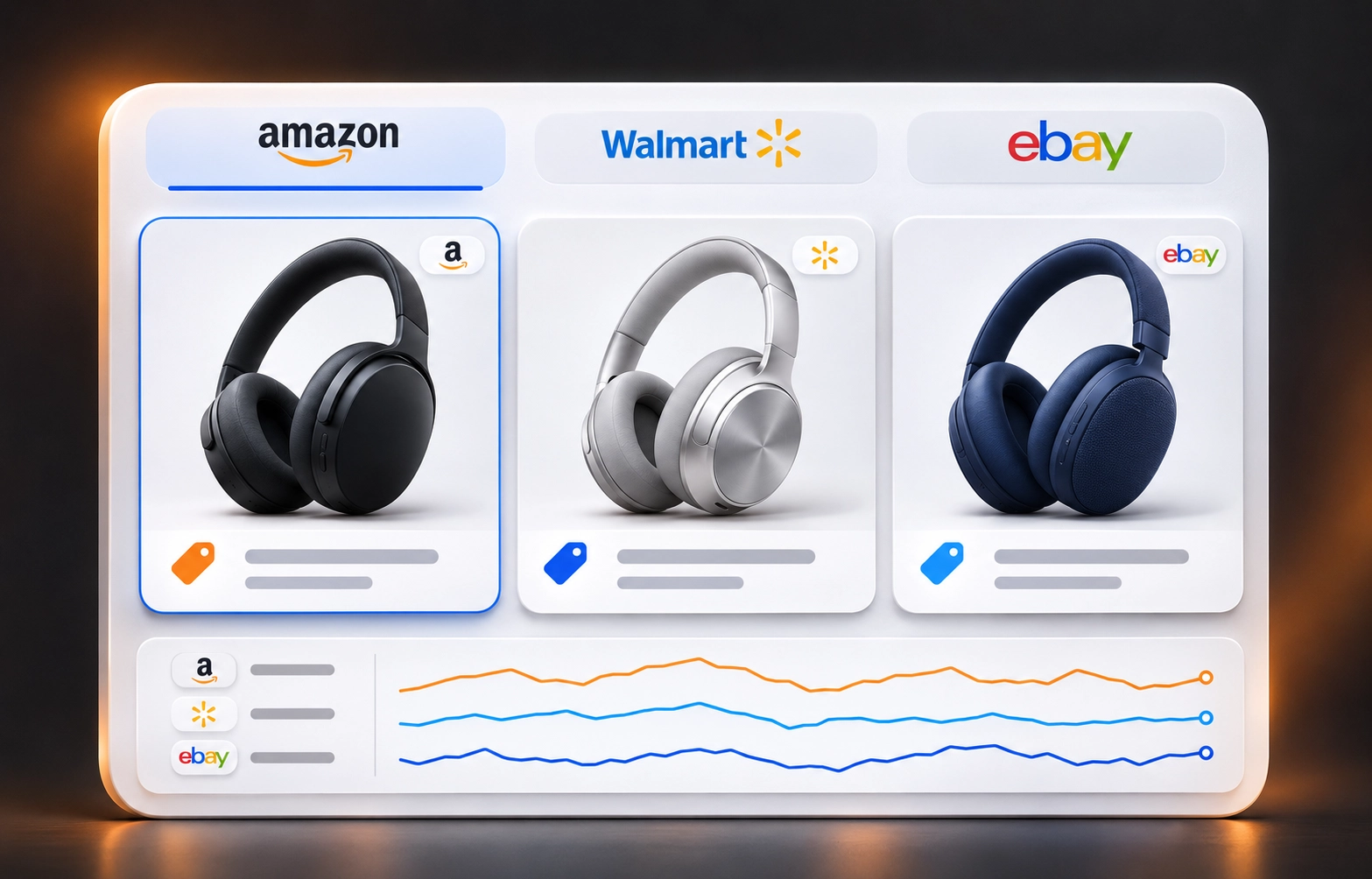
Competitor price monitoring vs. MAP monitoring
Both tools collect prices from the same marketplaces, which is why they get confused. The difference is in whose prices you are watching and what you do next.
Together they make up what many teams call competitive price intelligence. We cover how pricing data from both sources connects in our article on price intelligence for MAP compliance.
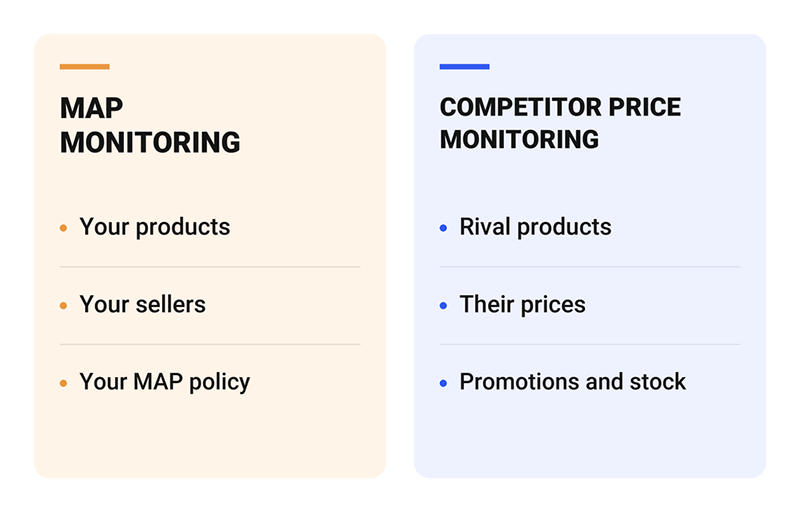
| Criteria | MAP monitoring | Competitor price monitoring |
|---|---|---|
| Whose products | Yours | Competing brands' |
| Question it answers | Are my sellers advertising at or above MAP? | Where does my price sit against the alternatives shoppers see? |
| What you do next | Notify and escalate with sellers under your MAP policy | Adjust your own prices, promotions, and MAP levels |
| Basis | Your unilateral MAP policy | Public market prices, used independently |
What should you track when monitoring competitor prices?
The list price alone gives a misleading picture. On a marketplace, shoppers compare the full offer.
- Advertised price: the price on the product page and in search results.
- Promotions: coupons, lightning deals, subscribe-and-save discounts, and bundle offers. A competitor’s effective price may be 15% lower than its list price if a coupon is clipped on the page.
- Landed price: price plus shipping. Amazon weighs the total cost to the customer, as we explain in how the Buy Box works.
- Stock status: a low price with low stock often means clearance, not a new strategy.
- Buy Box owner and price on competing listings: tells you whether the brand or a reseller is setting the competitive price.
- Unit price on multipacks: a 3-pack at a lower price per unit competes with your single unit.
- New products and variants: a launch at a lower price point can change the comparison overnight.
How to set up competitor price monitoring
- Define your competitive set. For each key product, pick the 2 to 5 products shoppers actually compare to yours. For most brands, that is fewer products than it feels like.
- Match products carefully. Compare like with like: size, pack count, model year, and UPC where available. Poor matching is the most common reason competitor data misleads.
- Choose your channels. Start where you sell the most, usually Amazon, then add the other marketplaces and retail sites where the competing products appear.
- Set a frequency. Daily works for most categories. Check more often around major sales events, when competitors launch products, or when your own sales data shows unusual patterns.
- Set alerts with thresholds. For example, a competitor price drop of more than 10%, a new coupon, or a stock-out. Alerts let you act without watching dashboards all day.
- Assign a decision owner. Data no one reviews is wasted. Review it weekly with the person who sets prices.
A spreadsheet can handle ten products checked by hand once a week. It breaks down once you track dozens of products across multiple channels at daily frequency. That is when a tool becomes necessary.
How to read competitor price data without starting a price war
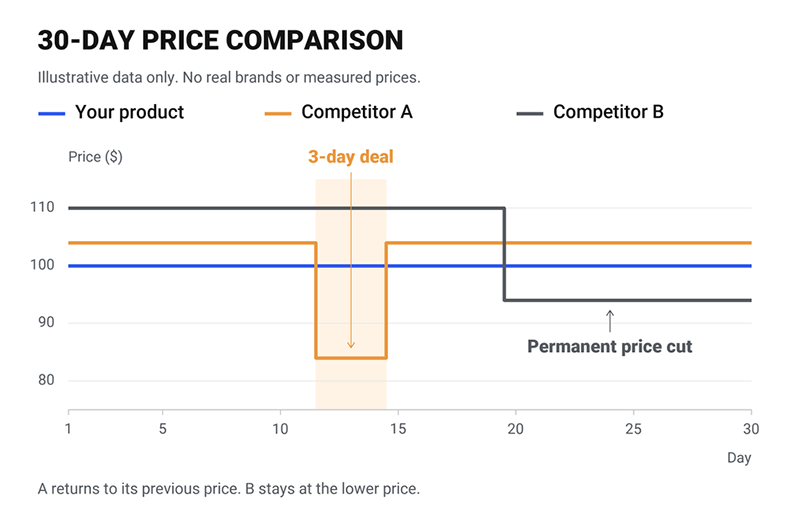
The point of tracking competitor prices is better decisions, not automatic price matching. Price is one signal among many, and matching every move your competitors make will often cost you more margin than the volume it recovers is worth.
- Check duration. A 48-hour deal and a permanent price reset call for different responses.
- Check stock. If the cheaper competitor is nearly sold out, waiting may be the best move.
- Compare the full offer. Shipping, coupons, ratings, and delivery speed all shift what shoppers will actually do.
- Watch your own results. If your conversion and Buy Box share hold, the competitor’s lower price may not be pulling customers away.
- Look for patterns. Competitors who discount at the same point each quarter are predictable. Plan around them instead of reacting each time.
- Watch the top end too. Raising prices far above recent levels can cost the Featured Offer under Amazon’s pricing rules, which weigh competitiveness against external prices.
How competitor prices put pressure on your MAP program
When a competing product drops in price, your resellers feel it first. Their sales slow, and some respond by discounting your product to stay competitive, even if that means breaking MAP.
- Respond on your terms. If a competitor runs a long promotion, a brand-approved MAP holiday or promotional exception can let your authorized sellers compete without breaking policy.
- Expect more violations during competitor sales. Increase monitoring around those periods and keep your violation notices ready.
- Review MAP levels with data. If competitors have moved permanently, a MAP set two years ago may need a formal review, not a series of enforcement notices that go nowhere.
- Separate market pressure from repeat offenders. A reseller who breaks MAP every time a competitor discounts is a different problem from a reseller who discounts opportunistically.
Your own price record matters here too. Amazon now shows shoppers up to a year of price history on eligible listings, including promotions. A MAP holiday that runs too long or too deep can set shopper expectations that are hard to reset.
Is competitor price monitoring legal?
Yes. Watching the prices competitors publish and setting your own prices independently is normal competitive behavior. The legal line is coordination: agreeing with a competitor on what prices to charge, even informally, is price fixing.
- Collect prices from public sources: marketplace listings, retailer sites, and published ads.
- Make pricing decisions inside your company. Do not share future prices or pricing plans with competitors.
- Be careful with any arrangement in which competitors feed data into a shared tool that recommends prices to all of them. That can be price coordination even if no one speaks directly.
- When in doubt, involve your legal counsel. This article is general information, not legal advice.
What to look for in a competitor price monitoring tool
- Product matching that pairs your products with true equivalents, with a way to correct mistakes.
- Marketplace coverage for every channel where your shoppers compare prices.
- Frequency high enough to catch short promotions, with more frequent checks available during sales events.
- Price history for you and each competitor, so you can tell a deal from a reset.
- Promotion and Buy Box data, not only list prices.
- Alerts and exports that fit how your pricing team already works.
- One view with your MAP data, so competitor moves and reseller behavior sit side by side.
Where Brand Alignment fits
Today, Brand Alignment monitors the pricing of your own products every two hours across 200+ marketplaces, with seller-level price history, Buy Box history, and timestamped screenshots for MAP enforcement.
Want competitor pricing in your dashboard? Talk to our team about early access, or request a demo of our current MAP monitoring platform while competitor intelligence is in development.
Frequently asked questions
What is competitor price monitoring?
It is the ongoing collection of competing brands’ prices, promotions, and stock levels across marketplaces and retail sites, used to inform your own pricing and promotion decisions.
What is the difference between competitor price monitoring and MAP monitoring?
MAP monitoring checks whether the sellers of your products advertise at or above your Minimum Advertised Price. Competitor price monitoring tracks the prices of rival brands’ products. One protects your policy; the other informs your pricing.
Is it legal to track competitor prices?
Yes, when you collect publicly available prices and make your own pricing decisions independently. Agreeing with competitors on prices is price fixing, which is illegal under U.S. antitrust law.
How often should I check competitor prices?
Daily is enough for most categories. During major sales events, check several times a day, since competitors may change prices more than once.
Should I match competitor price cuts?
Not automatically. Check how long the cut lasts, the competitor’s stock, and your own conversion and Buy Box share first. Small price changes have a large effect on profit.
Can I monitor competitor prices on Amazon?
Yes. Competing products’ prices, promotions, and Buy Box owners are visible on their product pages, and monitoring tools can record them over time for comparison with your own listings.
Sources
- Price fixing, Federal Trade Commission, Guide to Antitrust Laws
- Amazon Marketplace Fair Pricing Policy, Amazon Seller Central
Take control of your marketplace presence with fast, effective brand protection strategies.
Every day, unauthorized sellers and MAP violations can erode your pricing, reputation, and revenue. Don’t wait for problems to escalate, start enforcing your policies and reclaim your market authority with our proven tools and expert support.




 Luis Amor